Your Vendor Protects Itself. Does Your Client Contract Protect You?
MSPs run on other companies' technology. A vendor's contract protects the vendor first, while your client contract may not protect you at all. Most large vendors won't renegotiate that gap, so the fix usually belongs in your client template or your next vendor renewal. The Vendor Risk Alignment Review compares the two contracts and tells you which one (or both) needs to be fixed.
Schedule a Scoping CallBronston Legal is an award-winning, nationally recognized information technology (IT) and telecom law firm.
Your vendor agreements were written to protect your vendors. Your client agreements were written to win and keep clients. Many MSPs never compare the two side by side until something goes wrong, and by then it's too late to renegotiate either one.
A routine cloud outage that causes your client $180,000 in losses could cost you $150,000 if your vendor's liability cap limits your recovery to $30,000.
We compare your critical vendor agreements against your client-facing contracts across seven areas where mismatches most commonly hide.
Whether your client liability cap exceeds, in real dollars, what you can actually recover from the vendor responsible. Most liability caps look reasonable until you convert them to dollars. Many are tied to fees paid, so the actual recovery may be a fraction of your exposure.
Whether your uptime and response commitments to clients outpace what your vendor actually guarantees you, and whether a real remedy exists upstream when the vendor misses.
Whether your client contract lets you pass a vendor's price increase through, with real notice and documentation terms, or whether you're stuck absorbing it for the rest of the term.
Whether your client agreement gives you room to respond, through notice, a good-faith adjustment period, and a right to terminate, when a vendor changes its terms, features, or data practices.
Whether your client-facing breach notification clock can actually be met, given what your vendor is obligated to tell you and when. Whether your vendor's indemnity and liability cap actually reach a security incident. And whether subprocessor use and data location are handled the way your client agreement assumes.
Whether your vendor indemnifies you on the same triggers and the same scope you've promised your client, or whether you're defending claims you can't pass back upstream.
Whether your vendor can exit, or decline to renew, faster than your client commitment allows you to, and what transition assistance or data portability you actually have if it does.
You provide your key vendor agreements and your standard client-facing agreements, including your MSA, SOWs, and order forms. We typically start with the vendors whose failure would cause the most disruption to your client revenue.
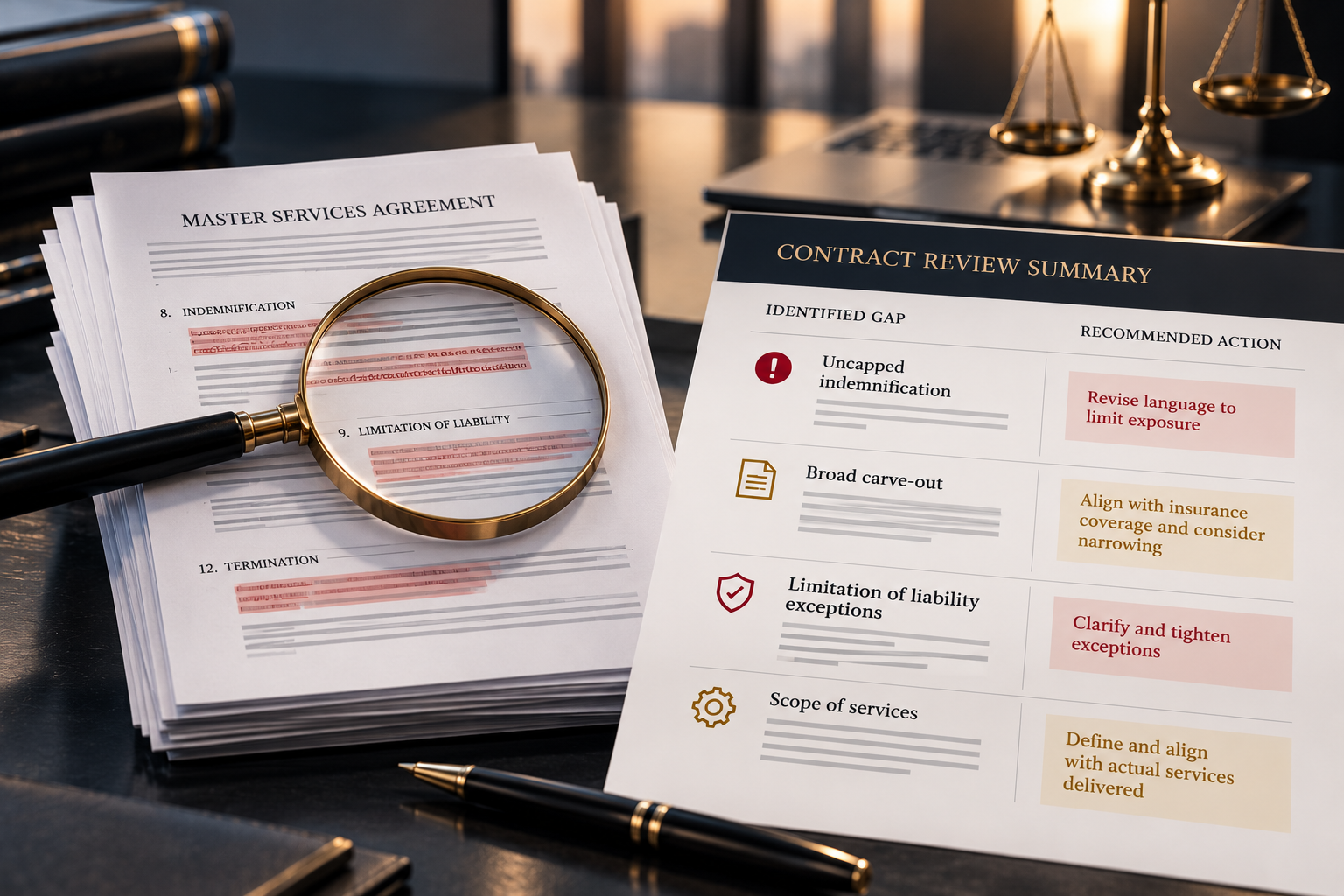
We compare both sides against the seven areas above, reading liability caps and remedies as dollar figures rather than formulas, and identify where your commitments to clients exceed what your vendors have actually promised you.
We walk you through what we found and sort every gap into one of three categories: fix it in your next client template, negotiate it upstream at your next vendor renewal, or keep it deliberately and price it into your fees.
A written summary organized by the areas above that identifies each gap and the recommended action.
The review focuses on your contract language. Where we flag a term, such as an uncapped carve-out or a broad indemnity, that commonly falls outside professional liability coverage, we'll note it and recommend confirming your actual coverage with your insurance broker. This review does not include an opinion on your insurance policies.
This is a legal review conducted by our attorneys. It is not a compliance certification, a security audit, an attestation, or a review of insurance coverage, and it does not represent that your contracts are free of risk outside the areas reviewed.
Reviewed against one set of your client documents (MSA, SOWs, and order form)
Flat fee
Schedule a Scoping CallReviewed against one set of your client documents (MSA, SOWs, and order form)
Flat fee
Schedule a Scoping CallScoped to your vendor list and client documents
Quoted individually
Schedule a Scoping CallWe confirm your vendor count on the scoping call before we quote.
These seven questions show where to start looking. If you can't answer more than one or two with confidence, it's worth having someone compare the actual language side by side.
If any of these gave you pause, a Vendor Risk Alignment Review is the next step toward finding out.
This self-assessment is provided for general informational and educational purposes only. It does not constitute legal advice, is not a substitute for legal advice, and does not evaluate, score, or rate your specific legal risk. Completing it does not create an attorney-client relationship between you and Bronston Legal. An attorney-client relationship is formed only through a signed engagement agreement.
This is not an audit. It's a legal review conducted by Bronston Legal's attorneys, not a certification, attestation, or compliance audit. You receive a written summary of where your contracts don't line up and what to do about each gap, not a pass or fail grade.
Sometimes we can, especially with smaller vendors or ones for whom you represent real volume. With hyperscalers and large SaaS platforms, their terms are published, click-accepted, and applied uniformly, and a mid-market account usually can't move them. When that's the case, the practical fix lives in your own client agreements instead: aligning what you promise with what you're actually guaranteed, building in a pass-through mechanism, and pricing the risk you choose to keep.
Internal reviews often look at one contract at a time, rather than comparing vendor and client agreements side by side, which is the comparison that usually doesn't happen until there's already a problem.
Pricing is tiered by vendor count: up to five vendors against one set of your client documents, six to ten vendors, or a custom quote above ten. We confirm your vendor count on a no-cost scoping call before quoting.
We don't need every vendor contract. We start with the vendors whose failure, price change, or disappearance would cause the most disruption to your client relationships, which usually means five to ten vendors, not your entire vendor list.
This isn't only for larger MSPs. The comparison matters whether you have five vendors or fifty, and smaller MSPs are often more exposed, not less, since they typically have less room to absorb a vendor's price increase or liability gap.
If you haven't compared your vendor agreements to your client contracts recently, or you've added vendors and clients faster than you've updated either, contact Bronston Legal at info@techlawyers.com or (888) 469-0579 to schedule a scoping call.